The Power of the Educational Interpreter by Amber Ceffalio

The Power of the Educational Interpreter

Let’s talk about your power as an educational interpreter. “I only facilitate communication,” you say, hiding behind your hands. “I don’t have any real power.” Be honest.  Next time admit, “I facilitate communication and impact, for better or worse, all situations I interpret.” One example of what comes after the ‘and’ is what we’ll discuss today.

The Situation

As an educational interpreter you have duties outside of classroom interpreting which include interpreting impromptu meetings between students and non-signing staff. Today, you’ve just been asked to escort a student to the Senior Advisor’s office so she can ask for her money back as she decided not to go to prom.

The Background

You’ve known this student for 3 ½ years now.  You know she’s never been in trouble, is very polite to adults, and tends to be shy. You also know the Senior Advisor and that she works well with the teenagers in the building including the deaf students.  You also know that the Deaf Services office has a good working relationship with the  Senior Advisor office. The meeting should take 5 minutes and be painless.

Your Power

Super Terp!

Super Terp!

Yet, have you considered that you could create tension in this situation? One goal of the Deaf Services office is for the seniors to be more independent.  Is now the time you’ll let your student advocate for herself?  Will you let the student struggle to ask for her money back, or will you lead the narrative? Will you nurture the relationship between the Deaf Services office and the Senior Advisor office, or will you Deaf Pride the place down? Will you voice aggressively? Passively? What kind of comments will you make to your deaf student while the senior advisor is processing her request? How about after you leave the office? These are the questions you should be considering on your walk to the Senior Advisor’s office.

What Happens

The deaf student leads you into the Senior Advisor’s office.  She signs, “Hi.”  Then she smiles and looks at you and looks at the senior advisor and she shrugs nervously and signs very small and very fast, “money. I-don’t know. Whatever.” And not ‘whatever’ with and attitude, but ‘whatever’ like, “nevermind.  I want to leave.”  Then she turns bright red.

Option #1–Lead

You voice, “Hi.  Its great to see you again.  Um, I hate to ask, but could I have the money for prom back because it turns out I can’t go. Is that ok?” You’ve stayed true to your student’s voice and intent but you added a lot of words and basically took over the entire conversation. Is that right or wrong? The senior advisor happily processes the refund because the student asked politely and she had a pleasant interaction with you.  The senior advisor has also had one more positive interaction with your office. You created a great outcome.  Just consider the expense.  Your student is no more independent now than when she walked into the office.

Option #2–Interpret literally

You voice, “Hi, um can I get my money back. Or, I don’t know. Whatever.” You’ve stayed true to the student’s words and perhaps her voice and intent. But, the senior advisor is unnecessarily confused.  Even the toughest kids have enter her office with courtesy and provide explanations for their requests. Your student will still get her money back, but the senior advisor will be left with a bad taste in her mouth.  She will be wondering why this deaf student was rude today when she never had been before.  Or, she’ll assume all the diva interpreters in the Deaf Services office are too big for their britches. You awkwardly forced your power onto a deaf student who didn’t want it, put your student in a bad light,  and broke down communication avenues between offices.

Option #3–Prep with your student

On your walk to the Senior Advisor office you ask your student why she is going to the office. (Who cares if you already know.  Ask anyhow.  You’ll be surprised what you learn.) Next ask your student if she wants to ask herself or if she wants you to interpret. Again, you may be surprised. You walk into the Senior Advisor office with your student and she sign, “Hi.”  She looks at you and looks at the senior advisor and then continues, “I can’t go to prom.  Can I get my money back?” This is the sweet and polite student your senior advisor knows. Of course she can get her money back and of course she loves working with the Deaf Services office.

Conclusion

Obviously, there are more than three ways this scenario could have played out. My point is: you impact the result of the interaction.  For good or bad, you’re part of the equation. Use your power to facilitate communication, yes! But don’t ignore the side effects of that power. Harness your power for a positive outcome.

Additional Readings: 

Ethical Choices: Educational Sign Language Interpreters as Change Agents  http://www.streetleverage.com/2013/04/ethical-choices-educational-sign-language-interpreters-as-change-agents/

What is the Role of the Educational Interpreter? http://www.classroominterpreting.org/Parents/Role.asp


You’re Not A Teacher

not a teacher

You Are Not a Teacher

By Amber Ceffalio, NIC

Last time we discussed the vast array of interpreting models an educational interpreter toggles through each day. Now, let’s discuss what an educational interpreter does not do.

You are not a teacher.

Yes, you’ll take on minor roles in which you impart information. Your student, for example, might ask you–not wanting to ask the teacher–if the next step in the math problem is to divide. OK, go ahead and answer their question.

Confirming for the student that they’re on the right path is different than big picture teaching. Here is where the roles of teaching and interpreting diverge.

A Teacher’s Role

Teachers have responsibilities that interpreters don’t have. Teachers walk into their classroom each day with specific information they wish to impart. Teachers prepare, teach, and assess the students’ understanding of that lesson. Teachers may adjust their lessons based on their assessment of a students’ comprehension.

On top of that, teachers enforce the rules of the school and are held accountable to the school administration.

An Interpreter’s Role

terp in classroomInterpreters interpret the teacher’s lesson. The interpreter assesses the Deaf students’ understanding of the interpretation, which is subtly, but vitally, different from the teacher assessing the students’ understanding of content.

Ideally the interpreter will be familiar with the content and know the teacher’s goals. But, an interpreter walks into the classroom with less preparation and less responsibility than the teacher.

Outside of interpreting, freelance interpreters aren’t accountable to the school administration. Yes, the interpreter is another adult in the room and needs to behave as such. Yes, the interpreter is a mandated reporter and the health and well-being of a student trumps the Professional Code of Conduct. But, the contracted interpreter isn’t necessarily mindful of the bureaucratic process of handing out bathroom passes while the teacher is. However, one must keep in mind that interpreters employed by the school district need to follow school district rules and protocol.

Complementing the Teaching Process

Interpreters can enhance or hinder the teaching and learning process.

1. First, the interpreter needs to be prepared for class. That may mean the interpreter is reading (or re-reading) To Kill A Mockingbird with the English class. It may mean that the interpreter is researching online what the chemical makeup of sugar looks like so she can interpret the information visually. This is baseline work.

2. Second, the interpreter has some information the teacher doesn’t have. How the interpreter uses this information will either be beneficial or detrimental to the teaching process. Because the interpreter is always looking at the student in order to assess if the student understood the interpretation, the interpreter sometimes catches information the teacher doesn’t.

For example, I was interpreting in a contained math classroom. The teacher was trying to teach a specific concept that was needed to understand future concepts. Frustrated because she’d been trying to get this information across in multiple ways, the teacher asked, “Do you get it now?” Frustrated because she’d been trying to understand but couldn’t, the student nodded. But, when the teacher turned to write the new lesson on the board, the student made a face that told me she didn’t understand the material at all.

What are my options? I’m part of the educational team, but I’m not the teacher. The teacher took the student at her word but not understanding to content now will hurt her later. I felt that the student was almost there and if the material was told one more time in a slightly different way, the student would get it. Yet, I’m not the teacher. I don’t want to be the teacher. And, I don’t want to undermine the teacher.

My solution was to sim-com, “Maybe I didn’t interpret that clearly. Did you mean that XYZ = ZYX?” With that, the teacher looked at me, looked at the student, understood exactly what was happening and said, “Yes, XYZ = ZYX and here is why…”.

lightbulbBoth the teacher and I saw the light bulb click on in the student’s brain.

Problems Come Up

That particular situation worked out because I approached the problem as if I was the weakest link in the educational chain. It also worked because the teacher didn’t have an ego to get around. We both shared a common goal.

Yet, we interpreters have a little bit of diva in us. (Raise your hand if you’ve ever thought, “I know more than this teacher.” We all have our hands up now.)

There are times I’ve crossed the line. The teacher usually points out these times with a sigh or an, “Ok, and getting back to my point…”.

Don’t take over the classroom. Defer to the teacher. She’s the one in charge and she’s the one who will ultimately answer to the school principal.

Discussion

Let’s crowd source educational interpreting. I illustrated one solution to one situation. I’m curious what other interpreters have done. In the comments, please tell us what you’ve done when you’ve noticed a student didn’t understand content but the teacher was moving on with the lesson. Let us know as much information about your situation as you can without compromising confidentiality. Was it was a mainstream or a contained classroom? What grade level? Did you have a rapport with the teacher? The more tools we share with each other, the better we’ll all be as educational interpreters.

Terps Up! Amber

Educational Interpreters: Who We Are and What We Do

Educational Interpreters: Who We Are and What We Do

educational interpreter

by Amber Ceffalio, NIC

Before the start of each school year, NYC educational interpreters gather to review interpreting policies and procedures. Beth Prevor, Director of the Office of Sign Language Interpreting Services, mentioned during the meeting that she likes to give us educational interpreters, “the freedom to do what we do.”  She added, “And that turns out to be a lot more than just interpreting.”

This column will explore what “a lot more than just interpreting” actually means.

Even though we do “a lot more than just interpreting”, most of the work we do is within our interpreting models. In fact, it’s not a stretch to say that an educational interpreter will use all of the models in any given day.

Let’s take a short walk through how an interpreter might use our models. Obviously, there are many more ways each model might be employed.

Helper: Interpreter acts as a tutor, either formally or informally.

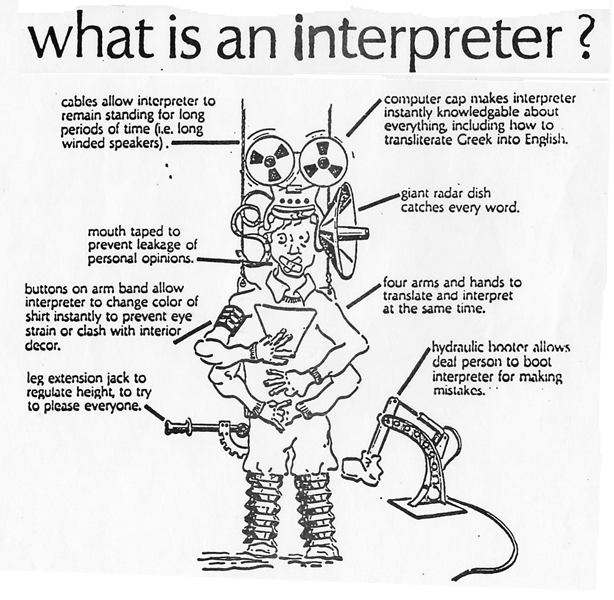
What is an interpreter

https://www.pinterest.com/pin/371054456773398240/

Conduit: Interpreter voices everything the deaf student signs, even if the deaf student doesn’t want you to.

Communication Facilitator: Interpreter understands the goal of the student and expresses it in such a way that the teacher understands what the student needs, even though the student didn’t know how to express their own needs.

Bilingual-Bicultural: Interpreter provides mainstream teachers with materials including information on how to set up closed captions.

Ally: Interpreter escorts the deaf student to the front office and helps the student ask for a special request.  The interpreter ends up being more than an interpreter as she leads her student’s questions.

Educational Team: Interpreters have access to information that teachers don’t have and it’s their responsibility to share that information with the appropriate people.

These are snapshots of situations when it’s ethically responsible to employ the various interpreting models. Educational interpreters don’t have the luxury of simply being a Communication Facilitator. Educational interpreters need to deftly and ethically toggle between the models to provide appropriate interpreting services in any given situation.

Other parts of “a lot more than just interpreting” land outside of our models. We are language models, for example.  We share information necessary information with teachers.  We are a confidants and sometimes informants.

What we do as educational interpreters is difficult to discuss in hypothetical generalizations. So, this column will open each week with a situation. We will use the situation to explore what we do, why we do it, and what options we have to make better informed decisions.

This isn’t, though, us laying down the educational interpreting law.  We want you to participate. Please, leave your thoughts in the comments.  What would you do in a given situation and why? We’d like a healthy and respectful discussion on educational interpreting.

Do you have a situation you’d like to discuss? Email me at amberala@gmail.com. We’ll remove identifying characteristics in order to keep identities confidential.  Yet we’ll make the situation specific enough so we can agree on the parameters.

Happy terping! Amber

To learn more about Amber click here and here.

Amber Ceffalio

Amber Ceffalio, NIC Writer & Interpreter

Click here for more information on sign language interpreter models.

More on classroom interpreting here.

“IN THAT SPACE, WE ARE THERE”: John Lee Clark’s Where I Stand: On the Signing Community and My DeafBlind Experience.

“IN THAT SPACE, WE ARE THERE”: John Lee Clark’s Where I Stand: On the Signing Community and My DeafBlind Experience. A reflection by T. K. Dalton

Book cover of "Where I Stand" by John Lee Clark

Book cover of “Where I Stand” by John Lee Clark

John Lee Clark opens his brilliant essay collection Where I Stand with a burst of poetry: “As a DeafBlind person, standing for me is almost never about being still or in one place.” He describes waiting for a bus, marking time with his feet in order to observe his surroundings. Communication intensifies this habit, he writes, especially when that dialogue is between DeafBlind people: “I would always find myself emerging from an engrossing conversation standing in a different place.” Interpreters who read Clark’s collection may finish the book with a similar reaction. On any given workday, a freelancer can encounter a hearing consumer with no knowledge of ASL, followed by another who views deafness as a medical malady, then by and a third with deep knowledge of the culture, all before lunchtime. Clark’s essays show an equally impressive span, offering insight in equal measure to community insiders, newcomers and novices, and complete outsiders. As skilled an essayist as he is a poet, he deftly adjusts each argument–”Does Disability Really Need to be Fixed?”, “A Cochlear Implant Thought Experiment,” “Why Hearing Parents Don’t Sign”–to match its audience and, importantly, to challenge the assumptions that audience might hold. His work isn’t “for hearing people only,” either. Clark writes one of the clearest explorations of why people “quit” the Deaf community I have ever encountered in “Great Expectations,” an essay that grows to pose a universal question of what any community can and cannot do for its members.

John Lee Clark

John Lee Clark

Like any great collection of ideas, these live beyond the printed page. One essay, “An Open Letter to American Heritage Dictionary”, led to an actual revision of the newly-added term “audism.” Another excellent piece, “ASL and the Star-Spangled Banner”, has also resonated with Deaf audiences. The remarkable re-thinking of the national anthem as a more accurate and contextualized visual narrative led to this amazing re-rendition by the Rocky Mountain Deaf School. The translator team of fourth and fifth graders also produced an impressive self-analysis. Here, and throughout Where I Stand, Clark brings attention to language as both a means to social justice for his community and as an aesthetic end worthy on its own. He is, after all, a poet. The insights into community life should make the collection required reading for anyone involved in the Deaf-World. But interpreters, after all, are language people, and Clark’s thoughts on poetry in English and in ASL will invigorate anyone who cares about language. He devotes a whole essay to Paul Hostovsky, a talented poet who works as an interpreter. In an essay that appeared in the prestigious magazine POETRY, Clark reviews two centuries of poetry by American Deaf people. (He edited the groundbreaking anthology Deaf American Poetry as well as, in the interest of disclosure, the anthology Deaf Lit Extravaganza, to which I contributed fiction.) Clark compares the brilliance of performed ASL poetry to the dearth of recorded ASL literature, and pithily diagnoses the latter with a “movie problem.” The lack of ASL literature, he argues, stems from the medium itself, and the ingrown problem that performed video differs fundamentally from written text. A written text, he writes, “creates space for us to say things as ourselves. And it creates space, when we are reading it, to fall into that text. In that space, we are there. And that’s how ASL literature will finally get there, too.” Theorizing about the medium of a message could quickly become overly abstract. To Clark, though, medium is a message. One crucial meta-message reflects his experience of (in)accessible media. On one extreme, he writes comically about his thwarted attempts to abandon heavy Braille issues of magazines in “All the Things I Can’t Leave Behind.” Conversely, the lack of these heavy tomes leads him to pose “A Question That’s Harder Than It Should Be”: Should Clark-the-poet send his work to magazines that Clark-the-reader cannot, well, read? The aforementioned POETRY magazine, Clark says, is the only poetry journal to offer hard-copy issues in Braille. (Anyone, then, can read his poem “My Understanding One Day of Fox Gloves.”) Where I Stand closes with essays on the author’s particular DeafBlind experiences, and these are the most moving, the most personal. While Pro-Tactile and Skyways and changing attitudes make this “an exciting time to be DeafBlind”, our age is not perfect. “I Didn’t Marry Annie Sullivan” debunks the assumptions Clark confronts regarding his personal life, and “Unreasonable Effort” rails against the institutional challenges faced by DeafBlind college students. Throughout the collection, Clark slaloms gracefully through his arguments’ logic. He extols writers with disabilities to write about people with disabilities. He parodies ‘people first’ language where a DeafBlind character struggled to run an errand at a social service agency where the new red tape is the zealous application by staff of politically correct terminology. Clark describes his school for the Deaf in exquisite detail in a piece that first appeared in Deaf Lit Extravaganza. This piece shows the subtlety that is Clark the essayist at his best. Clark’s vision has changed over time, and those changes permeate the piece powerfully. Deaf schools, of course, have unrivaled importance in the formative experiences of many Deaf people. For Clark, the beauty of the Minnesota State Academy for the Deaf “encouraged [him] to use a cane and retire [his] eyes to a life of leisure.” This particular place, remembered by this particular author, exists in memory only. This is true for any alumna, but the nostalgia takes on a potent edge, because this is a place the remember-er can no longer see. But the embedded power is this: the speaker forgoes eyesight, overrules its necessity, using language and memory to share with everyone his vision. To learn more about John Lee Clark go to:  www.johnleeclark.com For more information on the blogger visit: www.tkdalton.com/

T. K. Dalton

T. K. Dalton

Language in Motion…

"It's a duck!"

“It’s a duck!”

The beauty of ASL is seen clearly in the hands of the young.

Whether it’s identifying a duck in the water or relating signs of the season, we can see the simplicity and clarity of language in motion.

We look to the experts for language modeling when sometimes the beauty lies in the hands of the innocent.

Photo contributions from Amber Ceffalio & Susanne Morgan Morrow

"Pumpkin"

“Pumpkin”

Dilemma #1 Response

Technology, Interpreting & the Well-Meaning Helper by Jon Wolfe-Nelson

Jon Wolfe-Nelson

Jon Wolfe-Nelson

Working with technology and a live audience simultaneously is always tricky.

Technology will invariably glitch in some way and participants can behave in a surprising fashion. Even the most well-meaning helper can wreak havoc on your little interpreting utopia. Having experienced that exact situation recently I can share with you what I did and what I wish I had done.

While interpreting for a live Internet broadcast workshop I wandered a bit out of frame. A very well meaning participant; long-time volunteer, advocate and friend of the hosting organization decided the camera should be adjusted. What the participant did not know was that the presentation team and the interpreters had been in the room adjusting the single camera shot to be on an angle that would make my signs easily legible to the remotely viewing audience and set so as to not block the sight lines of the Deaf participants who were present in the room.

When I detected the interloper in my peripheral vision the participant was already reaching for the camera. I blurted out in a strong directive, “Please do not do that!” The response from the participant was, “You were off camera.” At which point the producer of the event took focus and made a general announcement that it is best that no one outside of the interpreting team adjust the audio/video equipment.

I made eye contact with my partner and we mutually agreed to be mindful of monitoring the frame of the broadcast screen. After all it is much easier for me to move back into frame than to re-position a camera on the fly.

Taken during live broadcast event

Taken during live broadcast event

Reflecting on the situation brings me to the following conclusions. I wish that I had insisted that my team interpreter sit closer to the interpreting area. Due to logistical demands, my partner was seated across a wide expanse of a dais and behind a table.  If we had stationed a chair in front of the table it would have been easier for my partner to intercept the well-meaning helper. Additionally, the speakers may not have had to be interrupted and I could have gone on interpreting. I also suppose I could have addressed the participant more sotto voce as not to draw additional intention.


 ~~~~~~~~~~~~


We do not have the answers to all scenarios and cannot possibly predict all of the “what ifs” in different environments. What is critical, however, is how we handle situations on the spot and then reflection with colleagues once the event is over. Thank you, Jon, for your sharing and your insights!

Susanne Morgan Morrow, MA, CI, CT – Professional Relations Consultant

Dilemma Question #1

Jon in action

SignTalk affiliate, Jon Wolfe-Nelson, hard at work.

Dilemma Question:

Jon, what do you do when you are
interpreting in front of a large room of
people while being simultaneously broadcast
across the web to multiple states and countless
viewers and someone comes to “adjust” your video camera?

And in this adjustment you are distracted
from your work, irritated that you were not
consulted as to the needs of the camera,
and now you are less centered in the picture
than before.

How do you handle this scenario?

When Sometimes Wrong is Right & Right is Wrong

moral dilemma ahead

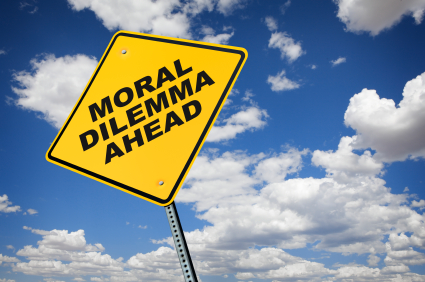
Ethical dilemmas. We are faced with them everyday. Interpreters are very often put into the position of Constant-Ethical-Dilemma-Decision-Maker or CEDDM for short – yes, we need another acronym! There are many times when the “right” decision feels wrong and the “wrong” decision feels right.  The decisions that interpreters make can have significant impact on the outcome of a meeting, shift the cultural platform and cultivate or destroy relationships.

So how do interpreters handle these scenarios? Naturally we have the RID Code of Professional Conduct to refer to. However, the CPC is merely a guideline for parameters of professional behavior, not a rule book to abide by. So interpreters need other guidance. This guidance is often difficult to seek out given the parameters of confidentiality. However, with experience, an interpreter begins to realize that there are ways to gain insight in safe and neutral ways.

right wrong decisionAs a working professional, any interpreter should be a member of the national organization representing his/her field and should be a member of the local chapter of interpreters. Through these memberships an interpreter will remain abreast on current trends in the field and have access to colleagues who may be more seasoned and who can act as confidential mentors. These mentorships often happen organically through conversations among professionals.

But perhaps a larger platform is needed, one to put real, hard, what-in-the-world-should-I-have done types of issues out there for a bigger group to hear and chew on. To address this issue SignTalk is offering a platform to discuss these issues. So we are asking you to submit some real life scenarios that were perplexing or challenging for you. These situations can be from you as a receiver of interpreting services or from the interpreting side of things.

ethical-dilemmas-notesSo let’s ask the “tough” questions, the “oohh, ouch” questions, the “I’m not so sure of the answer” questions. Send your scenarios/dilemmas to smorrow@signtalk.org and we will walk through these scenarios together with perspective from representatives from the deaf and interpreting communities.  

Let’s grow our awareness together – with each other – through community.

Susie

Sign Language in Action

love you

Language through the eyes of love.

Photography by Amber Ceffalio

Yes, sign language is beautiful. However, capturing brief snapshots of a language in motion is a challenge as you can lose some of the nuances that are richly unique to American Sign Language. Here Amber Ceffalio is able to catch a few of these beautiful glimpses in the language of young people. Continue reading

International Deaf-Blind Expo – Scholarship Recipient Response

By Barbara Russ Smith, MA, NIC

In August 2014 I had the great privilege to experience five wonderful, work-filled days at the first International Deaf-Blind Expo in Las Vegas, Nevada. Thanks to the generosity of the SignTalk Foundation, I was granted a scholarship to attend as a volunteer interpreter and Support Service Provider. Here I was able to work along with 25 other interpreters from around the country and across the world to interpret various workshops, such as “Know your rights under the ADA”, “The Basics of Pro-Tactile”, “Advanced Pro-Tactile”, “Meet the Federal Communications Commission”, and more. Over 175 DeafBlind attendees were present, many with at least one or sometimes two Support Service Providers (SSPs).  We all convened in a huge conference room the size of half a football field for the workshops. It was an awesome feeling to stand near the front of this room and look out at a sea of moving hands – hands that were learning, laughing, and socializing – a truly rewarding opportunity.

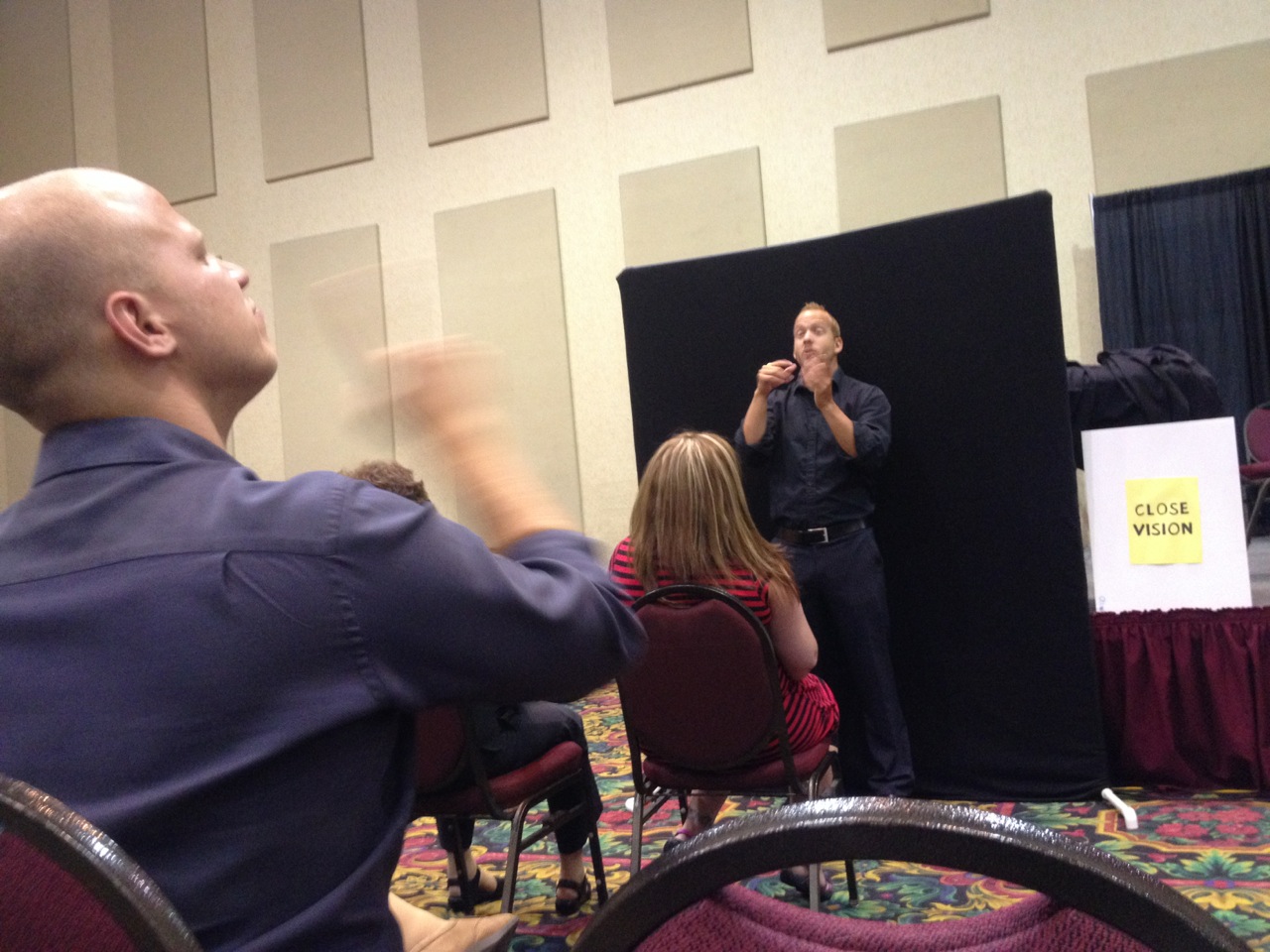
Ryan platformThe logistics of the communication set-up were impressive to observe.  In addition to the often multiple platform interpreters, there were different “stations” throughout the room that provided close vision and tactile interpreting. There was also live CART interpreting as well as voice-over support for individuals relying on their hearing for communication. Regardless of hearing and vision status – everyone had access to communication!  I had the good fortune of working with an interpreter from California and a top-notch CDI from Washington state. Although somewhat jetlagged from my flight, it was energizing to witness so many people, including the organizers and SSPs, working so diligently to make communication for such a diverse group seem so seamless. Continue reading